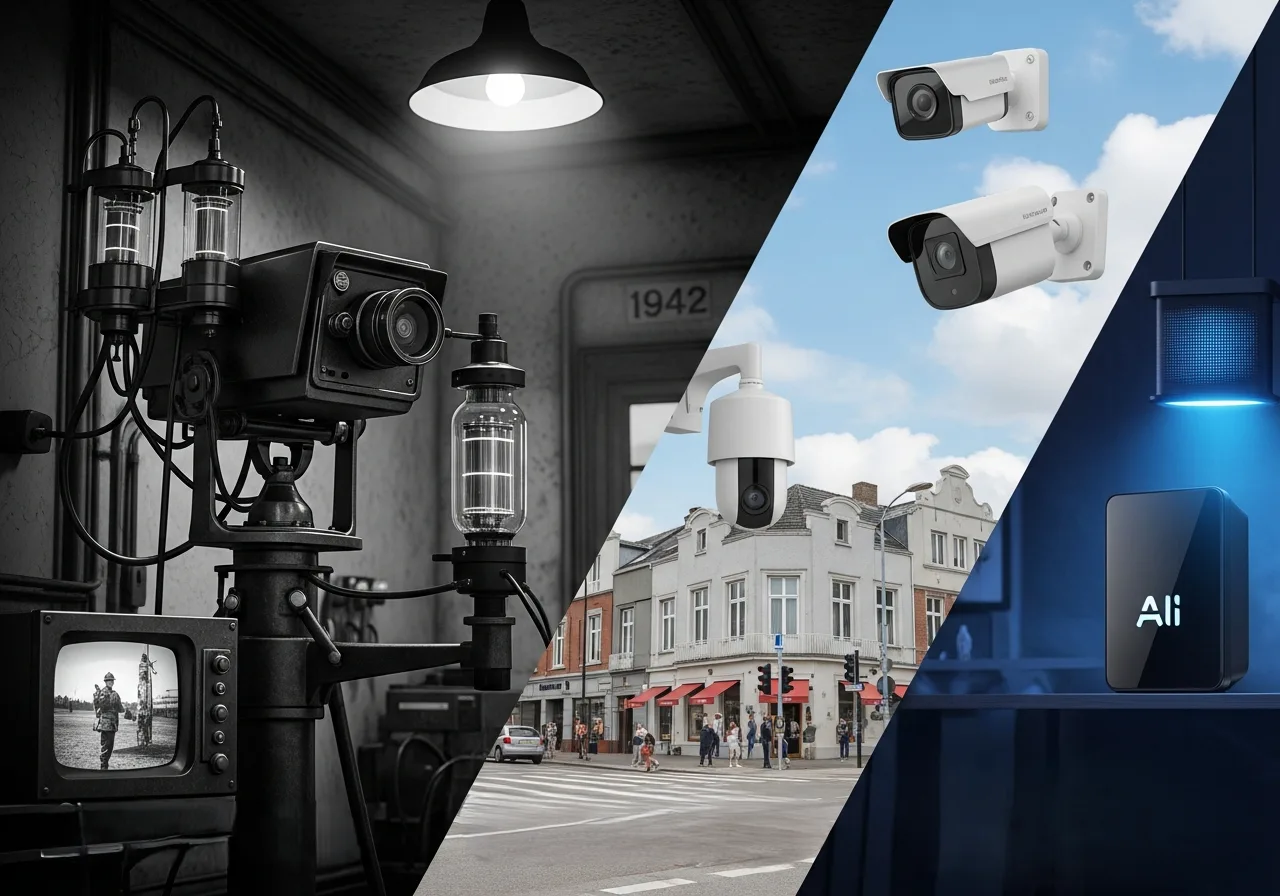
Engineers invented the first security camera during the chaos of World War II. Today, we take video surveillance for granted. We see it on our doorbells, in our local stores, and across our city streets. However, the question of exactly when inventors created security cameras takes us back to a surprisingly specific and highly secretive moment in history. Security cameras were first invented in 1942. The technology was born out of sheer necessity, designed by a brilliant engineer for military applications.
From those initial, grainy military monitors, the technology slowly transitioned into the public sphere. We saw the first commercial applications in banks and government buildings.
Eventually, the concept made its way into our neighborhoods, evolving from bulky hardware to sleek, smart AI systems. Understanding when scientists developed CCTV cameras provides a fascinating lens into technological progress.
In this comprehensive guide, we will explore the origins of the first-ever security camera and trace its incredible journey through the decades.
The True Origins: 1942 Germany
If you are wondering exactly when Walter Bruch invented the first security cameras, the definitive answer is the summer of 1942. The invention took place in Peenemünde, Germany, at a highly classified military facility. The brilliant mind behind this creation was a pioneering German engineer named Walter Bruch.
The military tasked Bruch with solving a highly dangerous problem. Scientists were developing and testing the V-2 rocket, but observing these launches up close was often deadly due to frequent explosions.
To protect the scientists, Bruch designed a system using standard broadcast television technology. However, instead of broadcasting the signal over the airwaves, he sent it directly through cables to a secure monitor. This was a revolutionary step in engineering. By wiring the camera directly to specific viewing screens, Bruch effectively created the world’s first CCTV camera. The system was entirely live. He designed it purely for real-time observation, as the technology to record video footage simply did not exist yet.
Scientists could sit safely in a bunker, miles away, and watch the rocket launches in real-time on a small, flickering screen. The first CCTV camera, invented in 1942, was an absolute triumph of wartime engineering. It fundamentally changed how humanity could monitor hazardous environments from a distance.
Therefore, whenever someone asks when engineers invented surveillance cameras, you can confidently point to Walter Bruch and the dangerous V-2 rocket test sites of World War II.
The Arrival of Surveillance in America
While European engineers developed the technology, the question often shifts to when inventors created security cameras in America. The United States did not take long to adopt and commercialize this incredible technology. The first major milestone occurred in 1949 with the introduction of a system called Vericon.
Unlike the military systems of Germany, the manufacturer proudly marketed Vericon for commercial use. The company famously advertised the system as requiring no government permits because it operated on a closed circuit rather than public airwaves. Throughout the late 1940s and early 1950s, these systems were incredibly expensive. The federal government and highly secure military contractors primarily utilized them.
However, by the late 1950s, the technology slowly began to seep into the private sector. Major financial institutions realized the massive potential of remote monitoring. This leads many to ask: Did security cameras come out in the 1960s? The answer is that while they existed prior, the 1960s marked the first truly public implementations.
In 1968, the city of Olean, New York, made history by installing cameras along its main business street to help police monitor for crime. Shortly after, in 1969, the New York Police Department installed a network of cameras near the municipal building and in Times Square. This marked a major shift. Surveillance was no longer just for rockets or bank vaults; it was becoming a fixture of American public life.
The Genesis of Home Security Cameras
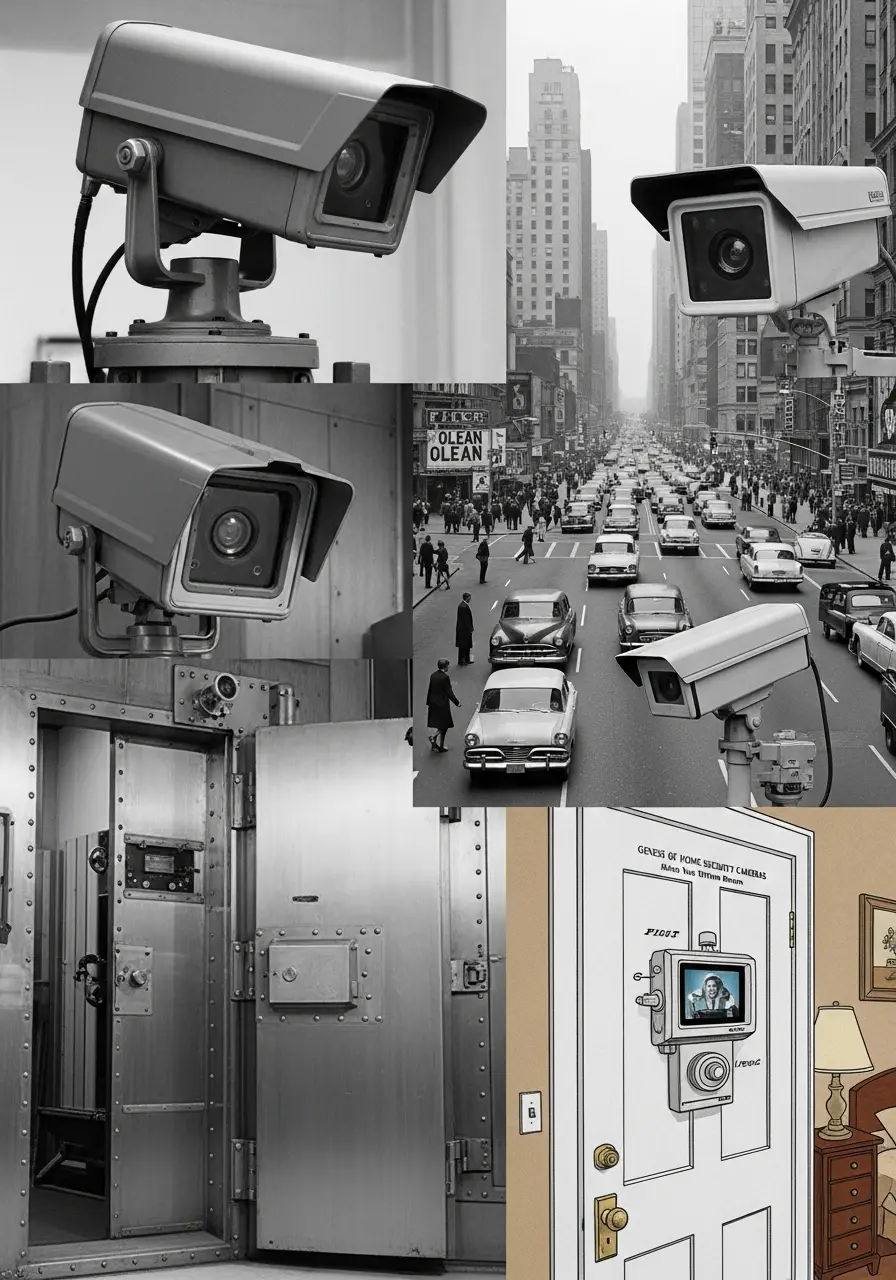
The evolution of domestic surveillance is a completely different yet equally fascinating story. If you want to know when home security cameras were invented, we must look to the late 1960s. In 1966, a nurse named Marie Van Brittan Brown, working alongside her husband Albert, filed a groundbreaking patent. They lived in Queens, New York, in a neighborhood dealing with rising crime rates.
Marie worked irregular hours and often felt unsafe opening her door to strangers. To solve this, she designed a system featuring a motorized camera attached to her front door. The camera could slide up and down to look through different peepholes. The video signal was sent directly to a television monitor placed in her bedroom.
This patent was officially granted in 1969, marking the true answer to when home security cameras came out. Her invention even included a two-way microphone to speak to visitors and a panic button to alert the police. Despite this incredible innovation, when security cameras were invented for homes is slightly different from when they actually became common in them.
The technology required to build Brown’s system was far too expensive for the average consumer in the 1970s. For decades, home security remained a luxury for the ultra-wealthy. It wasn’t until the late 1980s and early 1990s, with the miniaturization of electronics and cheaper manufacturing, that residential CCTV became commercially viable.
Today, Marie Van Brittan Brown is rightfully celebrated as the pioneer of the modern smart doorbell and residential security industry.
Early Uses of Security Cameras
Adoption in the Financial Sector
The banking industry was desperate for a reliable way to monitor vaults and teller stations. When security cameras were first used in banks, the date dates back to the late 1950s and early 1960s.
Before video, banks relied heavily on silent alarms and the unverified testimonies of witnesses after a robbery occurred. Early banking camera systems were clunky and required massive amounts of light to capture an image. Initially, these cameras didn’t record continuously. They were tied to alarms; if a teller pressed a panic button, the camera would begin snapping photographs or recording short bursts of video.
By the 1970s, continuous video recording became standard in financial institutions, serving as both a powerful deterrent and vital post-crime evidence.
Implementation in Educational Facilities
The integration of cameras into educational environments happened much later. If you are researching when security cameras were first used in schools, the significant shift occurred in the late 1980s.
Initially, cameras in schools were exceedingly rare and usually reserved for exterior monitoring to prevent nighttime vandalism. However, as concerns about bullying, internal theft, and student safety grew in the 1990s, indoor monitoring became increasingly prevalent.
The tragic events of the late 1990s, including the Columbine High School massacre, radically accelerated the deployment of security cameras inside school hallways and cafeterias.
Public and Municipal Monitoring
Public areas have always been a primary focus for surveillance technology. Early municipal deployments focused strictly on traffic monitoring and managing congestion in major urban centers.
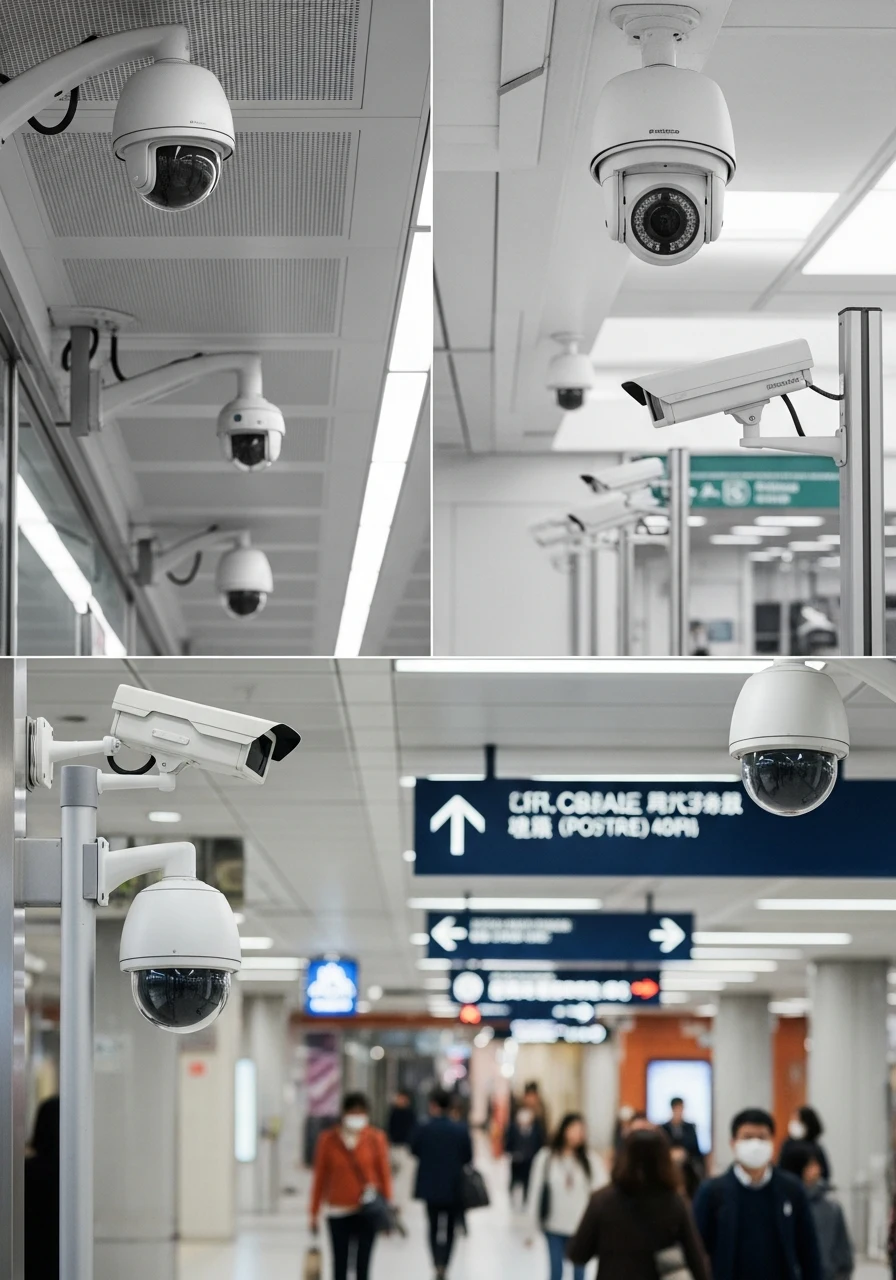
By the 1970s, transit authorities in cities like London and New York began installing cameras in subway stations to monitor crowds and deter muggings. These early public systems required dedicated rooms filled with walls of CRT monitors, crewed around the clock by multiple human operators.
The Era of Mainstream Popularization
Understanding the invention date is one thing, but when security cameras became common is a totally different timeline. Throughout the 1970s, the use of surveillance was still quite limited. Were security cameras common in the 70s? No, they were mostly confined to high-risk environments like casinos, banks, and major retail department stores.
The primary bottleneck in the 1970s was the recording media. Reel-to-reel tape was expensive, fragile, and required constant manual changing by dedicated security staff. The true tipping point, or when security cameras were popularized, occurred in the 1980s with the widespread adoption of the VCR (Video Cassette Recorder).
VCRs allowed businesses to record surveillance footage cheaply on standard VHS tapes. This made CCTV financially viable for small businesses, gas stations, and local convenience stores. The 1990s saw another massive leap with the introduction of multiplexers. This device allowed multiple cameras to record onto a single VHS tape simultaneously, drastically reducing equipment costs.
Then, the 2000s completely revolutionized the industry. The transition from analog tape to digital DVRs (Digital Video Recorders) meant footage could be stored on hard drives. This era also birthed the internet-connected IP camera, pushing surveillance into the mainstream and making it a standard feature of modern life.
Comprehensive Timeline of Surveillance Evolution
To truly grasp the history of this technology, we must look at the detailed milestones. This timeline maps out exactly how humanity transitioned from massive analog setups to tiny digital sensors.
1942: The very first CCTV system emerges in Germany. Walter Bruch successfully engineered this closed-circuit network to safely monitor dangerous V-2 rocket testing. The system remains live-view only and purely analog.
1949: The Vericon system launches. As the first commercially available CCTV setup in America, it required no government broadcasting licenses, paving the way for robust private sector utilization.
1950s: Early commercial implementation begins. These security camera setups are massive, heat-producing devices slowly adopted by federal facilities and elite banking institutions.
1960s: Street adoption starts as police test public surveillance. Concurrently, Marie Van Brittan Brown patents an innovative concept for early home security.
1970s: The crucial VCR breakthrough occurs. Before this, recording was incredibly difficult. Integrating VCR technology finally allows users to easily capture and store crucial security camera footage.
1980s: Widespread business adoption happens due to multiplex technology, allowing several cameras to record onto a single tape. This drastically lowers hardware costs for everyday retail stores.
1990s: The digital revolution arrives. Digital video recorders swiftly replace clunky VHS tapes. Video quality improves significantly, and finding specific incidents takes seconds instead of hours.
1996: The very first IP camera debuts. Axis Communications releases a network-connected camera, letting users view live feeds over computer networks instead of strictly closed circuits.
2000s: High definition and cloud storage expand. Cameras become significantly smaller and cheaper and boast much higher quality. Remote storage emerges, keeping surveillance footage safely off-site to completely prevent tampering.
2010s to 2020s: The AI Era. Cameras are no longer just simple recording devices. Modern smart systems now feature facial recognition, instant vehicle detection, thermal imaging, and seamless smartphone integration.
Characteristics of Early Footage
If you have ever searched for the earliest security camera footage, you will find that very little of it actually survives today. Because the very first-ever security camera systems in the 1940s and 1950s lacked recording mechanisms, those visual moments are entirely lost to history.
When recording became possible in the 1960s, it relied on magnetic tape that degraded incredibly quickly. Tapes were aggressively recycled and recorded over to save money. The footage that does survive from the late 60s and 70s is notoriously poor quality. It is entirely black-and-white, heavily distorted, and incredibly grainy.
Early lenses required immense amounts of light to capture an image. In low-light conditions, the subjects were often nothing more than blurry silhouettes. Despite the poor quality, this early footage laid the critical groundwork for forensic video analysis, fundamentally changing how law enforcement gathered evidence.
Decoding the Terminology
To fully grasp the history, it is vital to understand the foundational terminology of the industry. The most common acronym you will encounter is CCTV. The literal CCTV meaning is “Closed-Circuit Television.” But what does that actually mean from an engineering standpoint?
Standard television is an “open circuit.” Broadcasters send signals through the airwaves or public cable lines, and anyone with a receiver can pick up the channel. A closed circuit is the exact opposite. The camera is directly and privately connected to the viewing monitors, usually via specialized coaxial cables.
Because the loop is closed, the signal cannot be intercepted by the general public. It is designed entirely for private viewing and secure monitoring. While modern internet-connected cameras technically operate on computer networks rather than traditional closed cables, the industry still uses the term CCTV universally.
Technological Contrast: Past vs. Present
Comparing the systems of 1942 to the technology of 2026 is like comparing a horse-drawn carriage to a modern sports car. The evolution is truly staggering. Early analog systems were completely passive. They were essentially unthinking electronic eyes that sent a raw, uncompressed signal to a heavy glass monitor.
They required human operators to stare at screens for hours on end, waiting for something to happen. If the human blinked, the event was missed. Modern systems are highly active and intelligent. They are powered by advanced machine learning algorithms and neural networks.
Today’s cameras do not need a human to watch them. They can independently differentiate between a swaying tree branch, a passing dog, and a human intruder. They can instantly send a high-definition, full-color video clip directly to your smartphone while simultaneously backing up the data to a secure cloud server.
Frequently Asked Questions
When were CCTV cameras invented?
The very first CCTV camera system was invented in the summer of 1942. It was created in Germany for the specific purpose of monitoring military rocket tests.
Who created CCTV cameras?
A pioneering German engineer named Walter Bruch created the first CCTV system. He designed it to keep scientists safe while observing dangerous V-2 rocket launches.
Were there security cameras in the 1920s?
No, the technology did not exist yet. While photography and early broadcast television were in their infancy, the concept of a closed-circuit live surveillance feed had not been invented.
Did security cameras exist in 1999?
Yes, by 1999, security cameras were widely used globally. This era saw the rapid expansion of digital recording (DVRs) and the massive deployment of cameras in public spaces and schools.
What does CCTV mean?
The meaning of “CCTV” stands for “Closed-Circuit Television.” This means the video signal is transmitted only to a specific, limited set of monitors, rather than being broadcast publicly.
Conclusion
The journey of the security camera is a testament to human ingenuity. What began in 1942 as a desperate military tool has become a cornerstone of modern safety.
Walter Bruch’s early, grainy monitors paved the way for massive municipal safety programs, global banking security, and eventually, the smart home revolution. Today, surveillance technology is essentially invisible, woven seamlessly into the fabric of our cities and the architecture of our homes.
As we look toward the future, the integration of artificial intelligence will only deepen. Cameras will continue to evolve from mere recording devices into proactive security assistants. Understanding this history helps us appreciate the delicate balance between security, privacy, and the relentless march of technological innovation.